商品レビュー

GU38 vs GU63 vs T38 Plus: Which Geimori Grinder Fits Your Workflow?

GU38 vs GU63 vs T38 Plus: Which Geimori Grinder Fits Your Workflow?

THIRD-PARTY REVIEW EXPLAINER

GU38 vs GU63 vs T38 Plus: What This Third-Party Review Tells Us

Direct answer: Dimitris Dimopoulos’s hands-on comparison is most useful for understanding how these three grinders differ in real-world workflow, footprint, grounds handling and format. The T38 Plus stands out for compact plug-in use, the GU38 for a slim everyday countertop workflow, and the GU63 for a larger 63 mm conical-burr platform with greater dose capacity and adjustment range. The review is best used as a decision aid—not as a universal ranking.

Third-party review note: This is an independent editorial reading of the comparison video by Dimitris Dimopoulos from the EDC Coffee channel, a third-party reviewer with no stated Geimori affiliation. The video supplies the real-world comparison angle; current Geimori product pages supply the technical specifications. Geimori did not produce or sponsor the review.

Watch Dimitris Dimopoulos’s review

Geimori GU38 in a warm home coffee setup
GU38
slim everyday countertop format
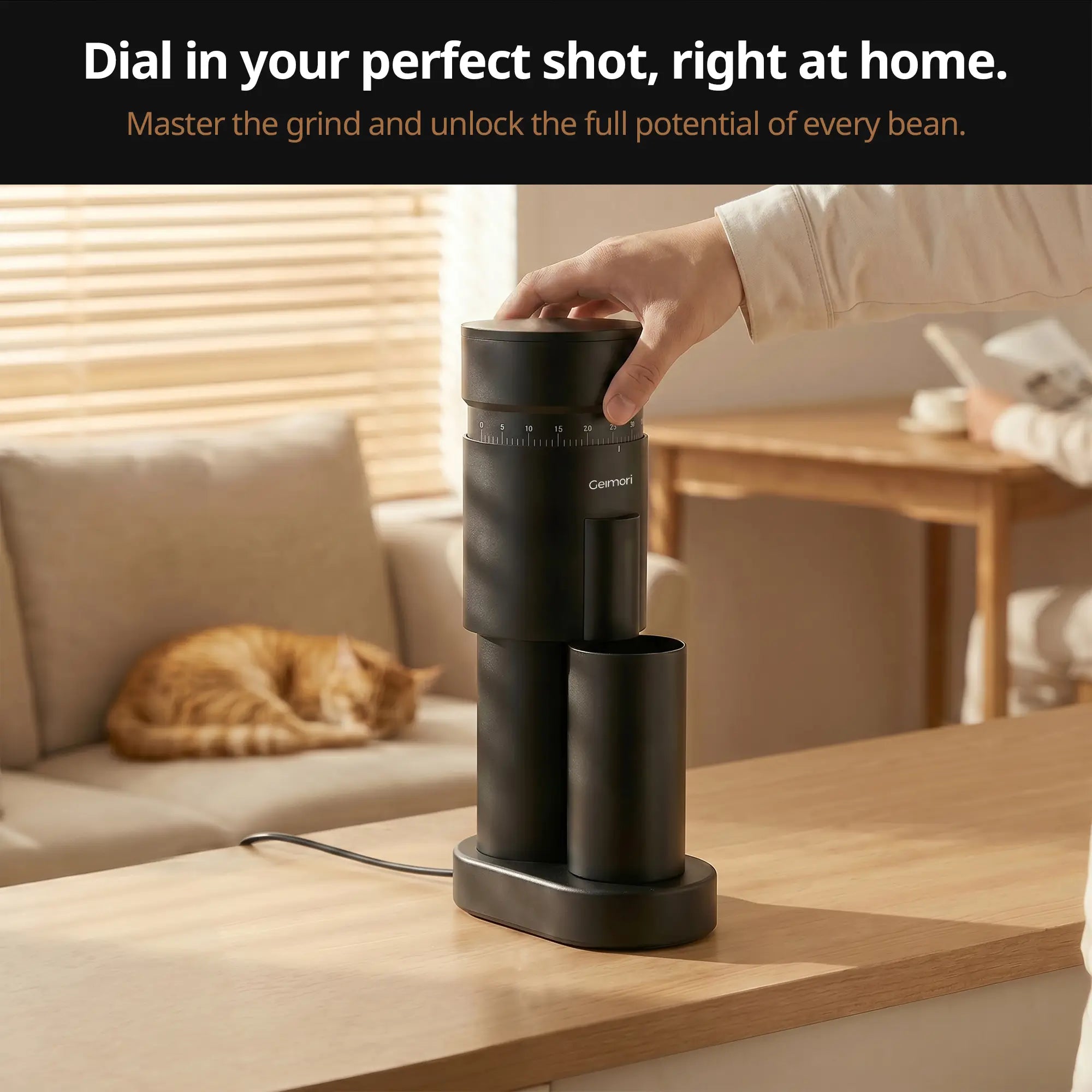
Geimori GU63 single-dose coffee grinder in a home setting
GU63
larger 63 mm conical platform
Geimori T38 Plus beside a pour-over coffee setup
T38 Plus
compact plug-in format

Official Geimori product imagery. The third-party video remains the source for hands-on review context.

The review in one minute

If this sounds like you Start with
Small kitchen, office setup or compact plug-in workflow T38 Plus
Filter-first brewing, occasional espresso and a slim metal body GU38
Larger conical burrs, more coarse-range flexibility and larger doses GU63

Check each current product page for live price, availability and market-specific delivery information.

What the video is useful for

The video is most useful as a buyer’s-eye comparison. By putting the grinders side by side, Dimitris makes differences in workflow, footprint, grounds handling and physical format easier to understand than they are on a specification sheet.

That matters because grinder buyers do not live with specifications—they live with the machine every morning. Counter space, dosing routine, cleaning, adjustment and how easily a grinder fits into a coffee setup can matter just as much as the headline burr size.

It is not the source of truth for every number. Product versions, regional listings and hardware revisions can change. The official product pages are therefore used to verify the figures below.

Use both sources: watch the reviewer for hands-on context, then use the official pages to confirm the model configuration you are actually buying.

How to read this third-party review

Dimitris’s video is most valuable as a decision aid, not as a replacement for a product manual. A reviewer can show how a grinder feels on a bench, how much space it occupies and which compromises become obvious during use. The official product pages can then confirm the burr type, motor, capacity, dimensions and power requirements for the model and market you are considering. Visit Dimitris Dimopoulos’s EDC Coffee channel for his wider review context.

That distinction matters because a reviewer’s preference is personal. A compact grinder may be ideal for one kitchen and frustrating for another; a larger hopper may help a batch brewer but add no value to someone who weighs one espresso dose at a time.

What the video helps you notice What to verify before buying
Counter presence and physical proportions Current dimensions and weight on the official product page
How the workflow feels at the bench Hopper, dosing-cup and duty-cycle specifications
Grounds handling and cleaning attention Model-specific cleaning guidance and included accessories
Which model suits the reviewer’s routine Your brew methods, dose size and available power outlet

The useful question is not “Which grinder wins the video?” It is “Which grinder fits the coffee I make and the way I make it?”

What the burr difference means—and what it doesn’t

One hardware difference is immediately clear. The GU38 and T38 Plus use 38 mm six-core conical burrs, while the GU63 moves to a 63 mm eight-core conical platform.

That is useful information, but burr diameter alone should not decide the purchase. The more practical question is what comes with each platform: adjustment range, dose capacity, grinding rate, physical size and how the grinder fits into a daily routine.

The current GU63 product page lists a 100 W DC motor at 80 RPM, a marked 0–85 stepless adjustment range, a 60 g hopper and a 70 g dosing cup. The GU38 and T38 Plus use smaller 38 mm conical-burr platforms in more compact formats.

These are measurable design differences—not proof that one grinder will taste better with every coffee. Coffee, roast level, recipe, calibration and personal taste all influence what ends up in the cup.

Current specification comparison

T38 Plus GU38 GU63
Burr platform 38 mm, six-core conical 38 mm, six-core conical 63 mm, eight-core conical
Adjustment Stepless, marked 0–65 Stepless, marked 0–5 on current page Stepless, marked 0–85
Motor 80 W DC · 170 RPM 80 W DC · 170 RPM 100 W DC · 80 RPM
Grinding rate Espresso 0.6 g/s; filter 0.84 g/s Espresso 0.6 g/s; filter 0.8 g/s Espresso 0.6 g/s; filter 1.1 g/s
Hopper / cup 30 g / 35 g 30 g / 40 g 60 g / 70 g
Dimensions / weight 70 × 101 × 234 mm / 1,234 g 162 × 90 × 317 mm / 2,375 g 155 × 98 × 305 mm / 3,068 g

Specifications are checked against the current product pages. Retention, noise and grind performance depend on coffee, dose, calibration and operating method.

Use the review as a starting point

Watch the hands-on comparison, then verify the model that fits your counter.

Dimitris’s video gives you the independent perspective. The official comparison guide gives you the current product context.

Watch the review Compare official specs

What the review reveals about daily use

This may be the most useful part of a side-by-side review. Specifications are easy to compare on paper; workflow is harder to understand until you see the machines occupying the same bench and being used for the same basic task.

Geimori GU64, GU38 and T38 Plus shown together in a comparison visual
Seeing all three grinders together makes the reviewer’s practical comparison easier to understand: footprint, format and daily workflow are the real differences this section is about.

T38 Plus: compact plug-in grinding

The T38 Plus is the smallest and lightest of these three. Its 234 mm height and 1,234 g weight suit a small counter, office station or setup that moves regularly. It is plug-in powered, so portable means compact and easy to relocate—not cordless.

GU38: a slim everyday grinder

The GU38 is a taller, heavier single-dose grinder with a slim 3.5-inch body. The current page positions it for filter-first users and occasional espresso, with 38 mm six-core conical burrs, stepless adjustment and a low-retention workflow.

GU63: the larger conical-burr platform

The GU63 combines 63 mm eight-core conical burrs, an 80 RPM motor, a 60 g hopper, a 70 g dosing cup and a 0–85 adjustment scale. The trade-off is physical: 3,068 g and a 305 mm height take more counter space and make moving the grinder less convenient than the smaller T38 Plus.

One thing the video cannot decide for you: taste

A hands-on comparison can show size, workflow, construction and practical differences. It cannot automatically tell you which grinder will produce the cup profile you prefer.

Coffee drinkers may prioritize very different things: body and texture, clarity and flavor separation, traditional espresso, lighter-roast espresso, filter coffee, milk drinks or versatility across several brewing methods.

That is why this review is more useful as a decision aid than as a universal ranking. Use Dimitris’s real-world observations to understand the machines, use the current product pages to verify the specifications, and then bring the decision back to the coffee you actually drink.

A useful buying sequence: coffee and brew method → preferred workflow → practical constraints → engineering specifications.

Which one should you explore first?

  • T38 Plus: choose it for compact, stable plug-in grinding.
  • GU38: choose it for a slim metal-bodied everyday grinder for filter coffee and occasional espresso.
  • GU63: choose it for a larger conical-burr platform, larger dose capacity and more coarse-range headroom.

If you need cordless brewing, compare the battery-powered Geimori T38. If flat-burr grinding is the priority, compare the GU64 Gen2.

Whichever model you start with, avoid reading the list above as a best-to-worst ranking. The point of the third-party comparison is to make the trade-offs visible so you can match them to your own routine.

Frequently asked questions

Are the GU38 and T38 Plus the same grinder?

They share the same listed 38 mm six-core conical-burr platform and 170 RPM motor, but their bodies, dimensions, base construction and workflow differ. Treat them as related models, not interchangeable products.

Is the GU63 faster for espresso?

The current GU63 product page lists 0.6 g/s for espresso, the same listed rate as the GU38 and T38 Plus. Its advantages are the larger burr platform, larger capacity and filter-rate figure—not a promised espresso speed advantage.

Is the T38 Plus cordless?

No. The T38 Plus uses a plug-in AC–DC adapter. For cordless brewing, compare the battery-powered T38.

Do the grinders work with different mains voltages?

The current product pages list 100–240 V, 50/60 Hz adapter input. A region-matched plug head may still be required for the outlet in your destination.

Ready to compare? Start with the coffee you make most often, then consider workflow, counter space, power format and the specifications that support those needs.

View the Geimori collection Watch Dimitris’s review
前へ
外部レビュアーが語るGeimori GU63の評価

コメントを残す

あなたのメールアドレスは公開されません。