
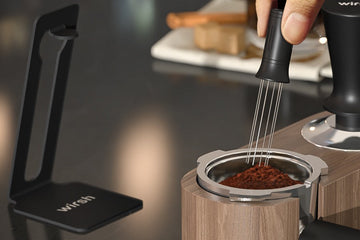
A WDT tool looks like a small handle with thin needles. It is not the most glamorous accessory on an espresso counter, but it can make one step of puck preparation more repeatable: distributing grounds before tamping.
What does a WDT tool actually do?
Fine espresso grounds can land in a basket in clumps or uneven piles. A thin-needle distribution tool lets you redistribute those grounds before you level and tamp the puck. The goal is an even bed of coffee, not a perfectly smooth surface for its own sake.
It is useful to distinguish distribution from tamping: WDT moves and separates grounds; tamping compresses the bed. You usually need to do both carefully rather than treating either step as a replacement for the other.
How to use WDT for espresso
- Weigh your dose. Use the basket's intended dose range as a starting point. Keep the dose consistent while you test a new technique.
- Grind into the basket. A dosing funnel can help contain loose grounds. If you use one, make sure it sits securely.
- Distribute gently. With clean, thin needles, stir through the grounds in small overlapping movements. Work from lower down in the basket toward the surface rather than just drawing shapes on top.
- Settle and level. Remove the tool without pulling coffee over the basket edge. A light tap or simple level-off can help before tamping.
- Tamp and brew as usual. Keep grind size, dose, yield, and tamping routine steady while comparing the results.
If you want to compare WDT with your usual workflow, make several shots both ways with the same beans, dose, grind setting and target yield. Look for repeatability in flow and, more importantly, taste. One good-looking shot alone does not prove a technique works better.
Do you really need one?
| Situation | Practical takeaway |
|---|---|
| Visible clumps or uneven grounds in the basket | WDT is worth a simple side-by-side trial. |
| Shots frequently spray or run unevenly | Try WDT, but also inspect grind, basket fit, dose and tamping. |
| Your current routine already produces consistent, tasty shots | There may be little benefit to adding another step. |
| Grinds cling to the chute or dosing cup | That may be static; WDT is not the same as RDT or anti-static technology. |
Choosing a WDT tool
Look for several thin, reasonably flexible, cleanable needles that can move through grounds without digging into the basket. A comfortable handle and stable stand are useful, but expensive features are not essential for a first test. Avoid unnecessarily aggressive stirring that disturbs the basket screen or bends needles.
Common mistakes to avoid
- Using thick or blunt prongs. They can shove clumps around instead of separating them.
- Only stirring the surface. The lower part of the basket may still contain unevenly distributed grounds.
- Changing five variables at once. You cannot tell whether WDT helped if you simultaneously change the beans, grind, dose and brew ratio.
- Assuming every fast or sour shot is channeling. First check your espresso grind setting and recipe.
Will WDT prevent channeling?
It can help with one contributor to channeling—uneven distribution—but it is not a guarantee. Flow also depends on coffee, particle distribution, basket geometry, puck preparation, water delivery and brew pressure. Our channeling troubleshooting guide offers a broader step-by-step check.
If your main problem is coffee dust sticking to the grinder or dosing cup rather than clumps in the basket, read about RDT and grinder static. They address related but different parts of the process.
Keep the workflow simple
Good espresso starts with a repeatable grind and dose. Try WDT as one small part of that routine, then decide whether it earns a permanent spot on your counter.


