
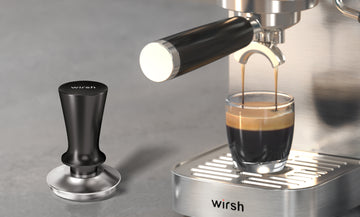
Wirsh Coffee Journal · Practical Guide
If your espresso tamp is crooked, you can make the same coffee and grind behave differently from shot to shot. Tamping is a consistency tool, not a competition to see who can push hardest.
What a tamper actually does
A tamper compresses and levels ground coffee in the portafilter basket. The aim is to make a repeatable starting puck. It cannot fix a poor grind or guarantee that water will travel evenly through the bed.
A simple tamping routine
- Match the tamper to the basket. Check the basket's internal diameter and the tamper dimensions; “58 mm” is only a nominal family.
- Distribute first. Break up visible clumps and level the dose with a suitable tool if needed.
- Keep the basket steady. Set it on a stable work surface or tamping mat.
- Press straight down. A firm, comfortable tamp is usually enough. Consistency matters more than an exact pound figure.
- Pull and taste. Evaluate beverage weight, flow and flavor rather than judging only the dry puck.
Tamp pressure: do you need a magic number?
You'll see claims that everyone must tamp with precisely 30 pounds or some other number. Treat that as a training cue, not a universal requirement. Once the coffee bed is compressed, keeping the puck level and your grind consistent usually gives you more to work with.
Still seeing channeling?
Look at the entire preparation chain: dose, distribution/WDT, tamp, basket choice, and grind. The channeling guide shows why tamping alone may not solve a spraying shot.
Remember that too little coffee for the basket, uneven distribution, or an unsuitable grind can all contribute to disappointing results. A careful tamp helps; it doesn't replace the rest of the workflow.


