

If you are comparing a standalone grinder with an integrated coffee system, start with the drinks you make and the equipment you already own. In her Forbes roundup, Bring the Coffee Shop Home With These Fancy Coffee Makers and Espresso Machines, contributor Terri Williams includes the Geimori GU63 and OXO Conical Burr Grinder with Scale among the accessories. Elsewhere, she explores complete coffee setups from brands including Aarke, Fellow and De’Longhi. Read the original Forbes article.

Together, these products raise a more useful question than which grinder wins: how much of your coffee routine do you want to manage yourself?
Some people enjoy weighing beans and refining a recipe. Others want a carafe ready for breakfast or a cappuccino selected on a screen. Those preferences lead to different purchases, even when everyone starts with the same bag of coffee.
Editorial note: This guide is written by Geimori, the brand behind GU63. Forbes is an independent third-party source; inclusion in its roundup does not constitute a head-to-head test or a ranking of these products.
Direct answer
Standalone grinder or integrated system?
A standalone coffee grinder makes sense when you already like your brewer, want to choose grinding and brewing equipment separately, or enjoy adjusting your coffee. A connected system or a coffee machine with a built-in grinder can suit a household that values coordinated dosing or guided drink preparation. GU63 sits on the hands-on side of that choice: a dedicated single-dose coffee grinder intended for espresso and filter coffee.
Start with what is already on your counter
If your espresso machine or filter brewer still does its job well, the first question is whether it needs replacing at all. Buying a separate grinder lets you change one part of the setup. Moving to a complete system also changes brewing, cleaning, counter layout and often the way everyone in the household makes coffee.
Starting from an empty counter is a different decision. A grinder alone is not a complete espresso setup: budget for the brewer, any milk equipment you need, a scale and the space to use them. Comparing the price of a standalone grinder with the price of a complete coffee machine tells you very little about the finished setup.
Write down the drinks you actually make, the equipment you already own and the steps you are happy to do every morning. That short list is a better starting point than a column of burr sizes.
Five ways to organize grinding and brewing
“Integrated” can describe a physical design, an automated task or simply a coordinated set of products. These are different things. A separate grinder can automate dosing; a machine with a grinder inside can still involve manual preparation.
| Format | Examples | What is coordinated? | What you still decide |
|---|---|---|---|
| Standalone, single-dose grinder | Geimori GU63 | Grinding is independent of brewing | Bean dose, grind position and brewer recipe |
| Standalone grinder with a scale | OXO Conical Burr Grinder with Scale | Grinder manages the selected dose | Grind selection, brewer and recipe |
| Connected, separate appliances | Aarke Coffee System | Grinder dose relates to the brewer’s water level | Coffee choice and preferred grind |
| Separate appliances sold as a kit | Fellow Aiden + Grinder Kit | A coordinated purchase of brewer and grinder | Grinder selection and preparation routine |
| Grinder built into a coffee machine | De’Longhi Rivelia; Breville Oracle Dual Boiler | Grinding and brewing share a machine; automation varies | Drink choices and the controls the model provides |
There is no universal progression from basic to advanced here. A separate setup may give you more freedom to combine equipment. An automated setup may do more of the work. Neither description, by itself, predicts which cup you will prefer.
GU63: a single-dose coffee grinder for espresso and pour-over
The GU63’s current product labeling lists 63 mm eight-core conical burrs, 80 RPM grinding, a plasma anti-static system and 85 marked adjustment positions. The adjustment is stepless: the markings are references along a continuous range, not 85 fixed clicks.
In a single-dose routine, you weigh the beans for one brew and grind that portion. Switching coffee becomes a deliberate choice for each cup. Keeping a note of the bean, dose and grind position gives you a starting point for the next brew; it does not remove the need to taste and adjust.
The appeal is easy to picture. You might use one coffee for morning espresso and another for a weekend pour-over, while keeping the espresso machine you already own. In that role, GU63 is an espresso and pour-over grinder that serves both routines without determining which brewer sits beside it.
There is a corresponding commitment: you handle weighing, transferring grounds and preparing the brew. If those steps sound enjoyable, the format may suit you. If they sound like obstacles between waking up and drinking coffee, a more automated setup deserves a place on your shortlist.
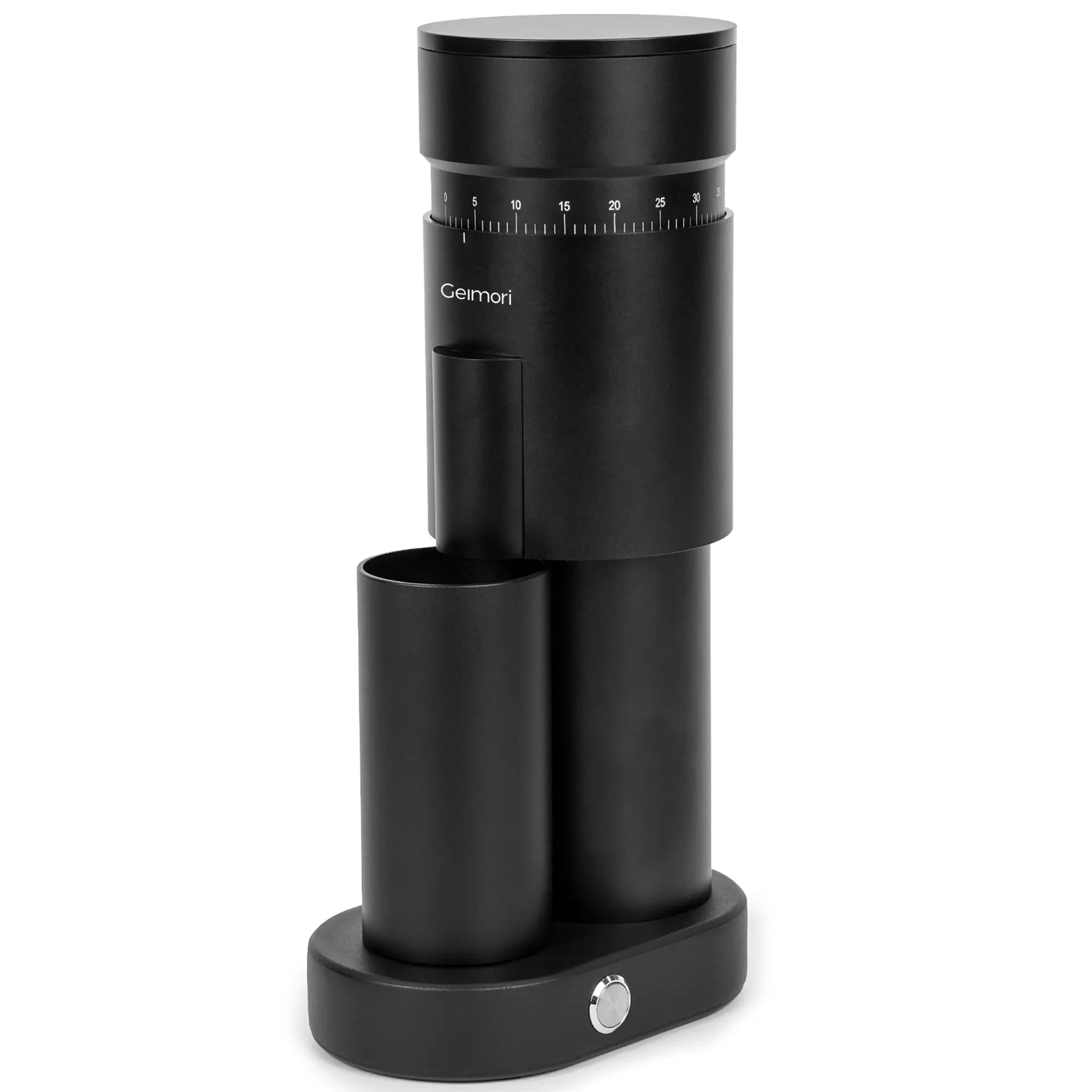
GEIMORI GU63
A dedicated place
for the grind.
Choose your dose. Refine your grind.
Keep the brewer you enjoy.
OXO: a coffee grinder with a built-in scale
The OXO model with an integrated scale demonstrates why “standalone” does not necessarily mean “weigh every dose yourself.” Its controls offer grams, cups and manual modes, combining a hopper with dose management inside the grinder.
That can appeal to someone who repeatedly brews the same coffee and wants fewer separate measuring steps. It still leaves the brewer independent. The practical comparison with GU63 is where you want to make the dosing decision: before the beans enter the grinder, or through the grinder’s controls.
OXO appears here as an example of a different routine. Its presence alongside GU63 in Forbes does not make the two products equivalent in price, adjustment design or intended ownership experience. Check the exact scale-equipped model when shopping; similarly named grinders need not have the same features.
Aarke: connected appliances, with filter coffee at the center
The Aarke Coffee System consists of a separate coffee maker and grinder. Its AutoGrind connection uses the water level in the brewer to calculate the amount to grind. Aarke lists 60 grind sizes and explicitly says the grinder is not optimized for espresso.
For a household that mostly prepares a carafe of filter coffee, coordinating dose with water quantity can remove a recurring calculation. You still choose the beans and grind; the system helps connect those choices to the amount you are brewing.
For an espresso owner, the decision is different. A filter-focused system answers a different need from adding an espresso-capable standalone grinder to an existing machine. Begin with the drink you want, then consider the convenience features.
Fellow Aiden: buying a pair without combining the machines
The Aiden + Grinder Kit is another way to build a coffee station. Aiden handles brewing, while the grinder remains a separate appliance. Fellow’s current kit offers a choice of grinders, so the selected configuration matters when comparing capabilities.
The useful distinction from Aarke is that a bundle is not, by itself, evidence of communication between the brewer and grinder. A kit can simplify the purchasing decision while leaving coffee preparation as a sequence of separate tasks.
For someone starting from scratch, a coordinated pair can be appealing. For someone who already owns a brewer they enjoy, purchasing a whole kit may solve a problem they do not have. Modular setups also allow one component to change later, although compatibility with your preferred brew methods still needs checking.

Built-in grinder coffee machines: look beyond the shared housing
De’Longhi’s Rivelia is a useful example of a fully automatic approach. The manufacturer describes grinding, dosing, brewing and frothing within a guided machine, with interchangeable bean hoppers and saved user preferences.
For several people sharing a kitchen, that changes the daily conversation. Instead of everyone learning the same manual recipe, users can select drinks and preferences through the machine. Swappable hoppers also show that changing coffee is not exclusive to single-dose grinders.
The Breville Oracle Dual Boiler is another built-in-grinder example in the Forbes roundup, but a common housing does not make every machine’s workflow identical. When comparing machines, watch the complete preparation sequence: which steps require moving a portafilter, which are automated, and what must be cleaned afterward?
A built-in grinder does not automatically mean less counter space, better coffee or no maintenance. Measure the complete machine and its access requirements. Leave room to refill water, reach the hopper, remove the drip tray and prepare drinks comfortably.
A different priority: coffee away from home
Forbes also includes the VSSL Nest Pour Over Kit with Java G25 grinder. Its place in this discussion is portability: fitting a brewing routine into luggage is a different problem from building a permanent espresso station. Treat travel equipment as its own branch of the decision, rather than ranking it against a countertop setup on convenience alone.
Three decisions that matter after the first week
1. Which manual steps are you willing to repeat?
Imagine making your second coffee while someone else needs the kitchen. Is weighing a fresh dose a pleasant ritual, or something you would rather automate? Will other people record grind settings and adjust a recipe, or would they prefer to select a saved drink?
Judge convenience across the whole routine: refill, grind, transfer, brew and clean. Saving one step is useful only if the remaining steps suit your household.
2. How often will you change coffee or brew method?
If you switch between beans, decaf and brew methods, consider how each setup handles those transitions. Single dosing makes the next bean choice explicit, but it does not guarantee an empty grind path. Hopper systems vary in how they handle bean changes. Follow the relevant manufacturer’s guidance rather than assuming either format eliminates carryover.
Changing from espresso to filter also means returning to a different grind range and recipe. A recorded setting helps you start; it is not a universal recipe that transfers unchanged between coffees or grinders.
3. What do you want to keep when you upgrade?
A separate grinder allows you to replace the brewer independently, provided the grinder supports the next brew method. With a built-in design, the two functions share a machine, which can affect upgrade and service choices. That does not mean every fault requires replacing the entire appliance; serviceability depends on the model and support available.
Independence is valuable if your preferences are evolving. If you already know exactly what you want to drink, a coordinated system can be equally deliberate. Choose for your likely routine, rather than a hypothetical future hobby.
Where GU63 belongs on your shortlist
Consider GU63 if you like your existing brewer, want to choose beans one dose at a time, and enjoy having direct control over grind adjustment. The strongest reason to choose this format is the freedom to shape the setup around your habits.
If your priority is repeatable hopper dosing, look at that feature specifically. If it is a coordinated filter-coffee station, consider a connected system or brewer-and-grinder kit. If it is saved milk drinks for the whole household, spend time with a fully automatic machine’s complete routine.
Our GU63 home espresso buying guide explores the model in more detail. You can also compare Geimori grinders if you have already decided that a separate grinder is right for your kitchen.
Build around the coffee you like to make.
Explore GU63 specifications and decide how a separate grinder would fit into your daily routine.
Explore GU63 →FAQ
Does a separate grinder always make better coffee?
No. The format tells you how the equipment is organized, not how every cup will taste. Coffee, recipe, grinder performance and brewing equipment all matter. This article compares daily routines rather than reporting a controlled taste test.
Does GU63 have 85 fixed grind settings?
No. GU63 has 85 marked positions, but its adjustment is stepless. The numbers provide position references along a continuous range rather than 85 discrete clicks.
Are Aarke and Fellow Aiden all-in-one coffee machines?
No. Aarke’s Coffee System connects a separate grinder and brewer. Fellow’s Aiden + Grinder Kit bundles separate appliances. Those arrangements differ from a grinder built inside the coffee machine.
Can I keep my existing espresso machine and add GU63?
That is the purpose of a separate-grinder setup. GU63 is intended for espresso and filter grinding; you still need to select the dose and dial in a recipe for your particular coffee and machine.


